By Hira Mehfooz
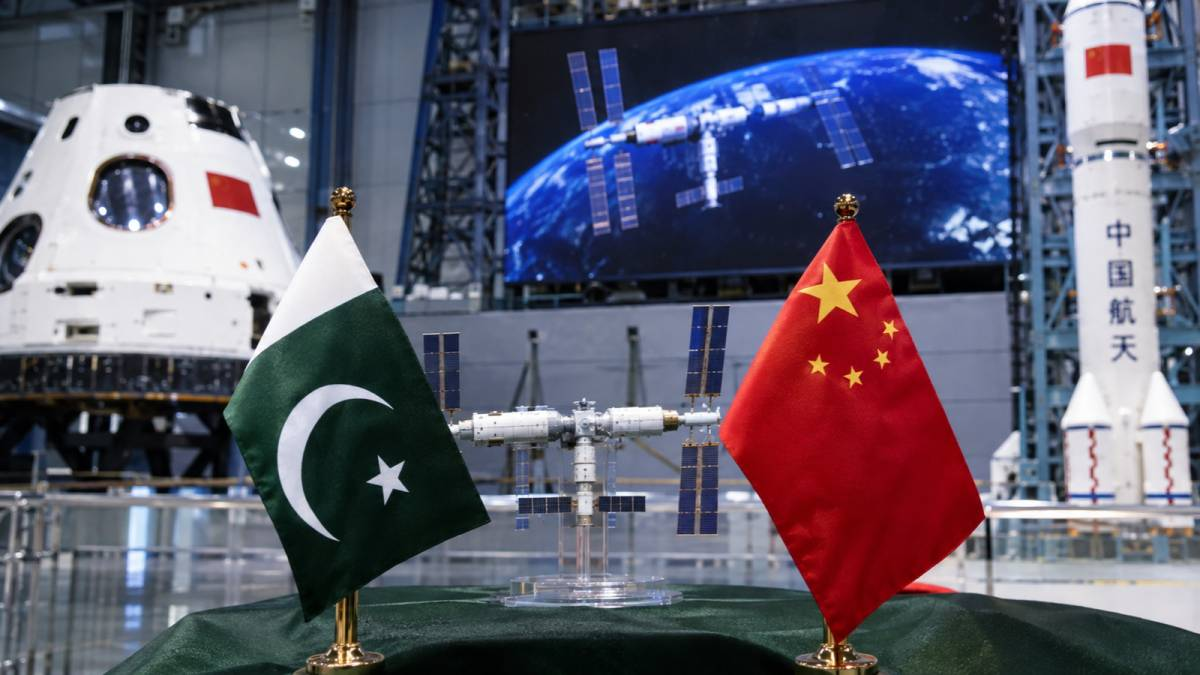
ISLAMABAD, Nov 24 (INP-Wealth Pakistan) -- Pakistan-China space cooperation is entering a historic new phase with the participation of a Pakistani astronaut in China's Shenzhou-24 crewed spaceflight mission, opening new avenues for scientific research, technological learning and the development of human spaceflight capabilities.
Pakistani astronaut Muhammad Zeeshan Ali has been selected as a payload specialist for the mission alongside Chinese astronauts Tang Hongbo and Wu Yi, according to an announcement by the China Manned Space Agency (CMSA) on Tuesday. Tang will serve as the mission commander.
The Shenzhou-24 spacecraft is scheduled to launch at 8:18 a.m. Beijing time (5:18 a.m. Pakistan time) on November 25 from the Jiuquan Satellite Launch Center in northwest China.
Ali is set to become the first foreign astronaut to visit China's Tiangong space station and the first Pakistani to participate in a Chinese crewed spaceflight.
The mission will also mark the first joint flight involving Chinese and foreign astronauts in the history of China's human spaceflight programme, representing a significant expansion of international cooperation in space exploration.
The development follows a cooperation agreement signed between Pakistan's Space and Upper Atmosphere Research Commission (SUPARCO) and CMSA in Islamabad on February 28, 2025, for the selection and training of Pakistani astronauts to participate in China's space station programme.
Under the agreement, two Pakistani astronaut candidates were selected following a three-stage screening process. Muhammad Zeeshan Ali and Khurram Daud completed their selection process in April 2026 and were chosen to undergo training in China. Ali was subsequently selected for the spaceflight mission, while Daud was designated as the backup astronaut.
The programme provides for specialised training at China's Astronaut Center, preparing the selected candidate to serve as a scientific payload specialist aboard the space station.
Unlike astronauts primarily responsible for spacecraft operations, payload specialists focus on scientific experiments and research activities. Their participation enables researchers to explore the effects of microgravity on biological systems, materials and other scientific processes, creating opportunities for knowledge-sharing and technological advancement.
Speaking to Wealth Pakistan, Senator Mushahid Hussain Sayed, Founder and Chairman of the Pakistan-China Institute, said Pakistan's participation in China's space programme marks a new phase in bilateral cooperation, extending the partnership beyond Earth into outer space.
He described the development as historic, saying it has taken Pakistan-China relations to new heights and reflected decades of mutual learning and cooperation between the two countries.
Muhammad Asif, Research Officer at Air University Multan Campus, told Wealth Pakistan that the mission could help Pakistan strengthen its scientific and technological capabilities through international research collaboration.
He said participation in space-based research could provide Pakistani scientists and academic institutions with opportunities to gain practical experience in microgravity experiments, scientific innovation and advanced space technologies.
Such exposure could also encourage young Pakistani researchers to pursue careers in science, technology, engineering and space research, contributing to the development of the country's scientific workforce.
China's Tiangong space station has developed into an orbital platform for scientific experimentation and technological testing. Its research activities cover various disciplines, including space medicine, microgravity physics, materials science and space technology applications.
For Pakistan, participation in the programme offers an opportunity to build scientific expertise through practical exposure to China's advanced human spaceflight infrastructure and research environment.
The progression from the signing of the bilateral cooperation agreement in February 2025 to the scheduled crewed mission in November 2026 reflects the pace at which Pakistan-China space cooperation has advanced.
Beyond its historic significance, the Shenzhou-24 mission represents an important step in expanding bilateral cooperation into advanced scientific and technological fields, with potential long-term benefits for Pakistan's research institutions, technological development and future scientific workforce.