By Muhammad Luqman
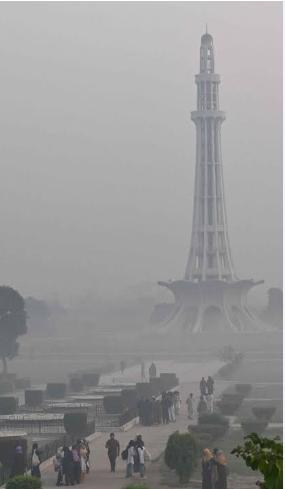
LAHORE, Nov. 18 (INP-Wealth Pakistan) -- Lahore needs a comprehensive urban air quality and land-use policy to tackle the recurring smog problem that has plagued the city for more than a decade, according to urban affairs experts.
“Rapid and uncoordinated horizontal expansion, coupled with heavy vehicular and industrial emissions, has pushed PM2.5 levels in the atmosphere to hazardous extremes,” said Dr. Ejaz Ahmad, Senior Research Fellow at the Institute of Urbanism (IoU), Islamabad.
Talking to Wealth Pakistan, he said integrating transit-oriented development, stricter industrial zoning and green infrastructure into urban planning could curb urban sprawl, reduce economic losses caused by pollution and balance population growth with environmental resilience.
“To build immediate momentum, policymakers should freeze approvals for new peripheral housing schemes on prime agricultural land while prioritizing feeder bus routes and pedestrian access around existing transit stations,” Dr. Ejaz Ahmad suggested.
Citing research by the Punjab Urban Unit, he said horizontal urban expansion and the conversion of agricultural and green spaces into built-up areas had caused substantial losses of urban tree cover. Trees naturally absorb carbon dioxide and filter particulate matter from the air.
“Between 2001 and 2025, Lahore lost substantial tree cover as its built-up area nearly doubled, surging from roughly 23% to over 47% of the city's land,” the urban affairs expert warned.
He said Lahore's heavy reliance on a car-centric development model, characterized by signal-free corridors, underpasses, flyovers and road expansions, had largely come at the expense of sustainable public transport and environmental health.
“By prioritizing private vehicles over the majority of commuters who travel on foot, by bicycle or via public transport, these infrastructure projects generate additional vehicular demand rather than resolving traffic congestion,” Dr. Ejaz Ahmad said.
He added that the surge in private motorization, combined with substandard fuel quality and fragmented mass transit integration, had significantly increased transport-related carbon emissions and particulate air pollution while compromising pedestrian safety.
Meanwhile, officials of the Punjab Environment Protection Department (EPD) said Lahore had recorded a 15% net improvement across six pollutants over the past year.
“Peak AQI fell by 28% in October 2026 compared with October 2025. The number of hazardous days, when the AQI exceeded 300, declined from four to zero,” said Muhammad Ali Ejaz, Deputy Director of EPD Lahore.
Talking to Wealth Pakistan, he said emission scanners would be installed at nine entry and exit points of Lahore under the Lahore Air Improvement Framework.
He added that the Environment Protection Authority (EPA) would establish a dedicated Vehicular Emission Testing Unit to operate the city's vehicle-scanning system.
Muhammad Ali Ejaz said a 1,000-member, technology-enabled Environmental Protection Force had been established to enforce environmental laws across seven major sectors.
He said the EPA had been fully digitized, with an online portal introduced for managing fines and cases.
The Punjab government has also banned tyre pyrolysis plants and the use of carbon powder as industrial fuel. Emission-control systems have been installed in more than 95% of industrial units, he said.
CCTV-based inspections are conducted through the Smog War Room, he added.