By Qudsia Bano
ISLAMABAD, Nov 18 (INP-Wealth Pakistan) -- The World Trade Organization's (WTO) renewed focus on ocean-based trade and development finance is opening opportunities for developing economies to move beyond traditional fisheries exports towards higher-value maritime services, coastal tourism, manufacturing and sustainable industries.
The initiative comes as global ocean-related trade reached approximately $2.5 trillion in 2025, with services accounting for 58% of the total, according to UN Trade and Development (UNCTAD).
The WTO estimates the broader global ocean economy at approximately $2.6 trillion, supporting around 133 million jobs. More than 80% of internationally traded goods are transported by sea, highlighting the close relationship between ocean sustainability, global commerce and supply chains.
The renewed focus follows the adoption of a declaration repositioning the WTO's 20-year-old Aid for Trade Initiative as “Aid for Trade: partnerships for trade and development.”
The declaration calls for greater use of grants, concessional financing and blended finance to mobilise additional resources and strengthen private-sector partnerships in developing economies.
Speaking to Wealth Pakistan, Shamaila Zareen, an economist at the Lahore School of Economics, said the greatest economic opportunities lay in developing value chains around ocean resources rather than relying primarily on unprocessed marine exports.
“The larger gains come when countries build value chains around their ocean assets. Fisheries can support processing and cold chains, ports can generate logistics and maritime services, while coastal resources can create tourism and specialised industries,” she said.
“For that transition, infrastructure and standards are just as important as access to the resource itself.”
UNCTAD data highlight the growing importance of higher-value activities in ocean-related trade. Services accounted for $1.44 trillion in 2025, representing 58% of total ocean trade, compared with 47% in 2020.
Marine and coastal tourism generated $785 billion in exports during 2025, while maritime freight transport accounted for another $487 billion.
Ocean-related goods trade exceeded $1 trillion, led by ships and port equipment worth $414 billion, high-technology manufactured products valued at $402 billion and fisheries and aquaculture at $209 billion.
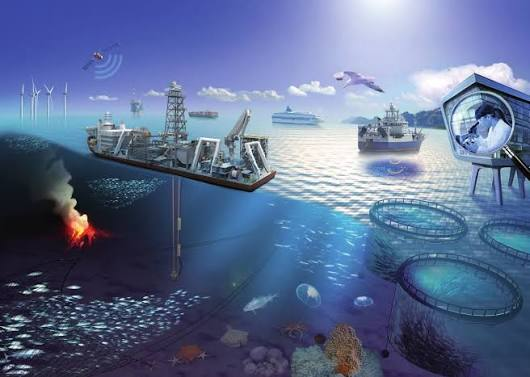
These figures illustrate how opportunities in the ocean economy extend beyond the extraction of marine resources to include transportation, tourism, technology, manufacturing and processing.
Dr Syed Amir Gillani, Assistant Professor at Bahria University Islamabad, said the expanding range of ocean-based industries created opportunities for coastal developing countries but also highlighted weaknesses in infrastructure and maritime governance.
“Having a coastline does not automatically create an ocean economy. Countries need efficient ports, reliable shipping links, modern fisheries management, quality certification and institutions capable of attracting investment,” he said.
Gillani noted that international partnerships promoted through the WTO could be particularly valuable for developing economies facing financial and technical constraints.
“International cooperation can help countries upgrade standards, develop port and cold-chain infrastructure and learn from economies that have already built competitive maritime sectors. The objective should be to convert geographical advantage into sustainable commercial capability,” he said.
The WTO's renewed ocean economy agenda also builds on its Agreement on Fisheries Subsidies, which entered into force in September 2025.
The agreement prohibits subsidies supporting illegal, unreported and unregulated fishing, fishing of overfished stocks and fishing on the unregulated high seas.
According to a WTO report prepared for the 2026 Aid for Trade Global Review, 43 project grants worth a combined $5 million had been approved by July to help developing economies implement fisheries-related commitments.
The WTO is also linking ocean development with its Trade Facilitation Agreement, the Dialogue on Plastics Pollution and programmes supporting standards and trade capacity.
Zareen said access to financing would be critical in determining whether developing countries could translate these frameworks into tangible economic opportunities.
“Blue-economy strategies often fail because projects remain fragmented. Combining trade facilitation, concessional finance and private investment can create commercially viable projects while protecting the ecosystems on which those industries depend,” she said.
The WTO's renewed approach therefore highlights opportunities extending well beyond conventional fisheries, particularly in maritime logistics, coastal tourism, industrial processing and specialised manufacturing.
For developing economies, realising this potential will depend on their ability to combine investment, infrastructure development and international partnerships with effective environmental safeguards.
Such an approach could help countries develop higher-value exports, generate employment and attract investment while protecting the marine resources on which long-term ocean-based economic growth depends.