By Ayesha Saba
ISLAMABAD, Nov 17 (INP-Wealth Pakistan) -- Greater certainty around China-Canada tariff arrangements could encourage agricultural exporters to invest in processing facilities, modern storage infrastructure and export logistics. Extending favourable market access through December 2028 provides these businesses with a longer planning horizon.
According to agricultural and trade experts, predictable tariff arrangements can help exporters move beyond short-term transactions towards longer-term investments in value-added production, quality improvement and supply-chain infrastructure.
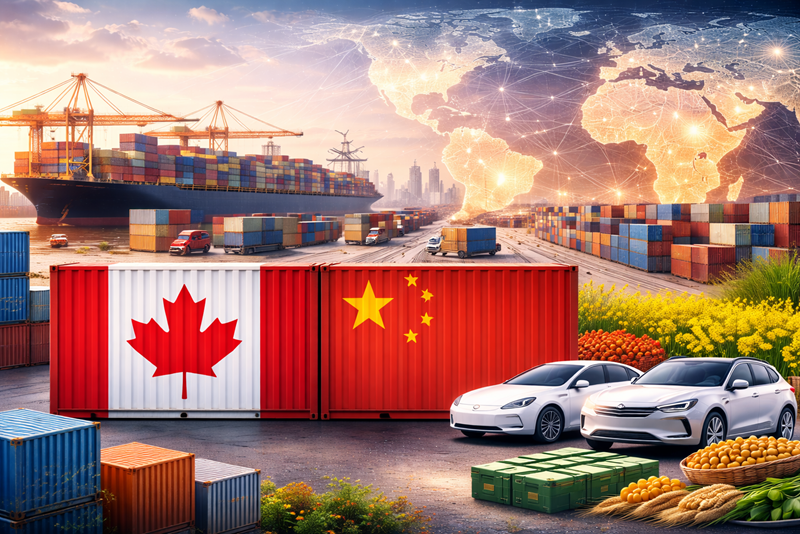
The extended arrangements, which cover selected Canadian agricultural and seafood products, including canola meal, peas, lobster and crab, could support stronger commercial relationships between Canadian producers and Chinese buyers.
Speaking to Wealth Pakistan, Ahtisham Iqbal, Senior Scientific Officer at the Pakistan Agricultural Research Council (PARC), said uncertainty over future market access remained a major challenge facing agricultural exporters.
“When tariff arrangements become more predictable, businesses can plan investments in processing, modern storage and quality improvement with greater confidence, rather than limiting their activities to short-term export transactions,” he said.
Iqbal explained that longer-term tariff certainty could encourage exporters and processors to assess investment opportunities that might otherwise be difficult to justify under uncertain trading conditions.
The assessment follows the November 4 announcement by Canada's Minister of International Trade confirming an agreement with China to extend favourable market-access arrangements for Canadian canola meal, peas, lobster and crab until December 2028.
According to Global Affairs Canada, the extension was agreed during a meeting of the Joint Economic and Trade Commission, co-chaired by Canadian International Trade Minister Sidhu and Chinese Commerce Minister Wang Wentao.
The arrangement builds on bilateral understandings reached during Canadian Prime Minister Mark Carney's visit to China in January 2026.
Under the earlier agreement, China suspended additional tariffs on Canadian canola meal, peas, lobster and crab from March 1, 2026, initially until the end of the year.
The latest extension provides a longer period of favourable tariff treatment for the specified products, allowing exporters and importers to plan commercial activities with greater predictability.
China also reduced the combined applied tariff on Canadian canola seed to 14.9%, compared with the previous level of almost 85%, under the earlier trade arrangements.
The reduction for canola seed is separate from the extension covering canola meal, peas, lobster and crab, although both measures form part of the broader bilateral agricultural trade relationship.
Official Canadian figures underline the commercial importance of the Chinese market for agricultural and seafood exporters.
According to Agriculture and Agri-Food Canada, China was Canada's second-largest export destination for agricultural, agri-food and seafood products in 2025, with shipments valued at C$6.7 billion.
Canadian canola seed exports to China reached C$1.5 billion during the year, while canola meal shipments were valued at C$288.2 million.
Wheat exports stood at C$1.2 billion, followed by soybean shipments worth approximately C$971.7 million.
These figures highlight the vital role of bilateral agricultural trade and show how import stable market access is for producers, processors and exporters.
Iqbal said the extension could be particularly relevant for Canada's canola industry, where processing activities generate additional value through products such as vegetable oil and protein-rich animal feed.
“Greater certainty in the Chinese market could encourage Canadian processors to assess opportunities for expanding oilseed crushing and developing higher-value agricultural products. However, such decisions will also depend on raw material availability, processing costs and sustained international demand,” he explained.
He noted that tariff stability could give businesses greater confidence when evaluating investments in processing capacity and other facilities required to serve overseas markets.
However, he emphasised that favourable market conditions alone would not determine investment decisions, as commercial viability would continue to depend on production costs, supply availability and demand.
Iqbal also observed that stable export arrangements could strengthen coordination between farmers, processors and international buyers.
Greater predictability, he said, could help businesses develop longer-term procurement and supply contracts, improving commercial planning across agricultural value chains.
“Farmers benefit most when export opportunities are supported by reliable purchasing arrangements and efficient processing industries. Governments should therefore focus on improving agricultural productivity, reducing post-harvest losses and strengthening connections between producers and export-oriented enterprises,” he suggested.
The observations highlight the relationship between trade policy certainty and investment in agricultural infrastructure, particularly where exporters need reliable supply arrangements to meet overseas demand.
Dr Masood Ahmed, Assistant Professor at the Department of Governance and Public Policy at the National University of Modern Languages (NUML), Islamabad, told Wealth Pakistan that the China–Canada tariff extension reflected the growing importance of predictable commercial relations in international agricultural trade.
He said exporters increasingly faced challenges arising from changing tariffs, logistics costs and competition from alternative suppliers, making longer-term market-access arrangements particularly valuable.
According to Ahmed, tariff predictability could be especially important for seafood exporters because products such as lobster and crab require specialised handling, refrigerated transportation and dependable distribution networks.
“Seafood exporters operate under strict time and quality constraints. More predictable access to the Chinese market could encourage companies to improve cold-storage facilities, strengthen refrigerated logistics and develop dependable relationships with overseas buyers,” he explained.
He noted that investment in cold-chain infrastructure could help seafood businesses maintain product quality, reduce losses and improve delivery reliability.
Such improvements could become more commercially attractive when exporters have greater confidence about future trading conditions and the continuity of access to major overseas markets.
However, Ahmed cautioned that favourable tariffs alone would not guarantee higher export earnings.
He said commercial performance would continue to depend on international demand, freight costs, regulatory compliance and competition from other exporting countries.
“Exporters should use the period of greater certainty to diversify their customer base, strengthen food-safety compliance and improve logistics efficiency. Depending too heavily on a single overseas market can create vulnerabilities if trade conditions change again,” he observed.
His assessment suggests that the extension provides an opportunity for exporters to strengthen their competitiveness rather than a guarantee of increased sales or investment.
While the arrangement directly benefits the specified Canadian products, the broader lessons are relevant to other agricultural and seafood-exporting economies seeking to expand their participation in international trade.
Ahmed said similar improvements in processing, storage and logistics could help Pakistan strengthen the competitiveness of its seafood exports, particularly in markets where freshness, food-safety certification and delivery reliability are essential.
“Pakistan's seafood industry could benefit from modern cold-chain infrastructure, efficient port handling and stronger quality-control systems. Such investment would help exporters reduce post-harvest losses and improve access to higher-value international markets,” he explained.
He further observed that Pakistan should pursue diversified agricultural trade relationships while strengthening its commercial engagement with China and other major importing economies.
For Pakistani exporters, upgrading cold-chain facilities, port handling and compliance systems could help expand seafood exports and unlock more demanding international markets.
The experience also highlights the importance of connecting trade opportunities with domestic investment in agricultural productivity, processing capacity and supply-chain efficiency.
For Canada, the extended tariff arrangements provide a more predictable commercial environment for exporters of the covered agricultural and seafood products through the end of 2028.
The longer planning horizon could support investment assessments, procurement arrangements and stronger relationships with Chinese buyers, although actual investment and export outcomes will depend on market conditions.
For other agricultural exporters, including Pakistan, the broader lesson is that stable trading relationships can create opportunities, but lasting competitiveness also requires efficient production, reliable logistics, product quality and diversified export markets.
The China–Canada arrangement therefore illustrates how greater tariff predictability can support longer-term commercial planning while encouraging businesses to consider investments that strengthen agricultural value chains and export competitiveness.